How Canberra Was Born: The Story Behind Australia’s Purpose-Built Capital
Posted by on
The creation of Canberra as Australia’s national capital marked a defining chapter in the country’s federation story. During the late 19th century, as Australia debated unification, a long-standing rivalry emerged between Sydney and Melbourne—both vying to become the nation’s capital. To resolve the impasse, a compromise was reached: the new capital would be established within New South Wales but at least 100 miles (160 km) from Sydney. Melbourne would serve as the temporary seat of government until the new city was built.
Several potential sites were surveyed, including Bombala, Albury, Tumut, and Dalgety. In 1904, Dalgety was initially chosen under the Seat of Government Act, but the New South Wales government refused to cede the territory. After continued negotiations, an agreement was made in 1906 that the new capital would instead be located in the Yass-Canberra region—closer to Sydney and considered ideal for its geography and climate. Newspaper proprietor John Gale played a pivotal role by distributing his influential pamphlet “Dalgety or Canberra: Which?” to politicians nationwide, helping sway the final decision in Canberra’s favor in 1908. By 1911, the Federal Capital Territory was formally established.
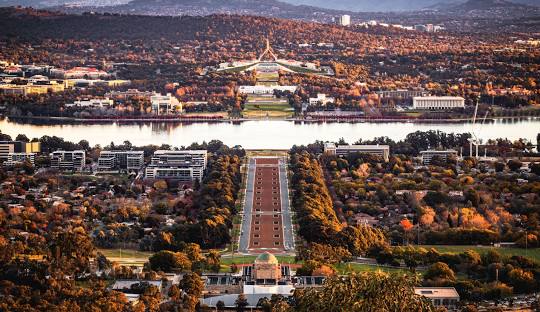
That same year, an international design competition was launched to plan the future city. Despite a boycott by several British architectural bodies, 137 entries were submitted. On 24 May 1912, American architect Walter Burley Griffin and his wife, Marion Mahony Griffin, were declared the winners for their bold and visionary city design. Although the government initially considered a modified version of their plan, the Griffins’ design ultimately prevailed. Construction began in early 1913, with Minister for Home Affairs King O’Malley driving the first peg to mark the beginning of Canberra’s development.
The following year, the government invited the public to suggest names for the new city, receiving nearly 750 entries. On 12 March 1913, at a ceremony held on Kurrajong Hill (now Capital Hill), Lady Denman, wife of Governor-General Lord Denman, announced the chosen name: Canberra. The day is now commemorated annually as Canberra Day.
However, bureaucratic challenges soon followed. Disputes over authority and limited funding slowed progress, and despite a Royal Commission in 1916 reinstating Griffin’s original plan, he was dismissed in 1920. Still, his influence remained enduring—his geometric layout, parklands, and lake system would come to define the city’s character. By 1927, Parliament House officially opened, and Canberra stood as the physical embodiment of a unified Australian identity—born out of vision, compromise, and creativity.